Whose event is it, exactly, when a line of horse trailers turns in toward Longfield Stables on a cool Saturday morning in October? Most residents who see the trucks assume it belongs to Palmetto Bluff, the way the farmers market or the FLOW Gallery openings do. The fall Hunter Pace held on Longfield's grounds is organized by the Lowcountry Hunt, which brings its riders, registration table, and scoring rules to Palmetto Bluff. The stable hosts. The club runs the show.
That distinction helps explain some of the differences residents notice on pace day: why the format feels different from a typical Longfield lesson or trail outing, why the crowd includes faces you don't recognize from the Club directory, and why the spring version of the same event, held every May, feels like an entirely different occasion even though it happens on the same 173 acres.
A Course an Olympian Built, an Event the Hunt Organizes
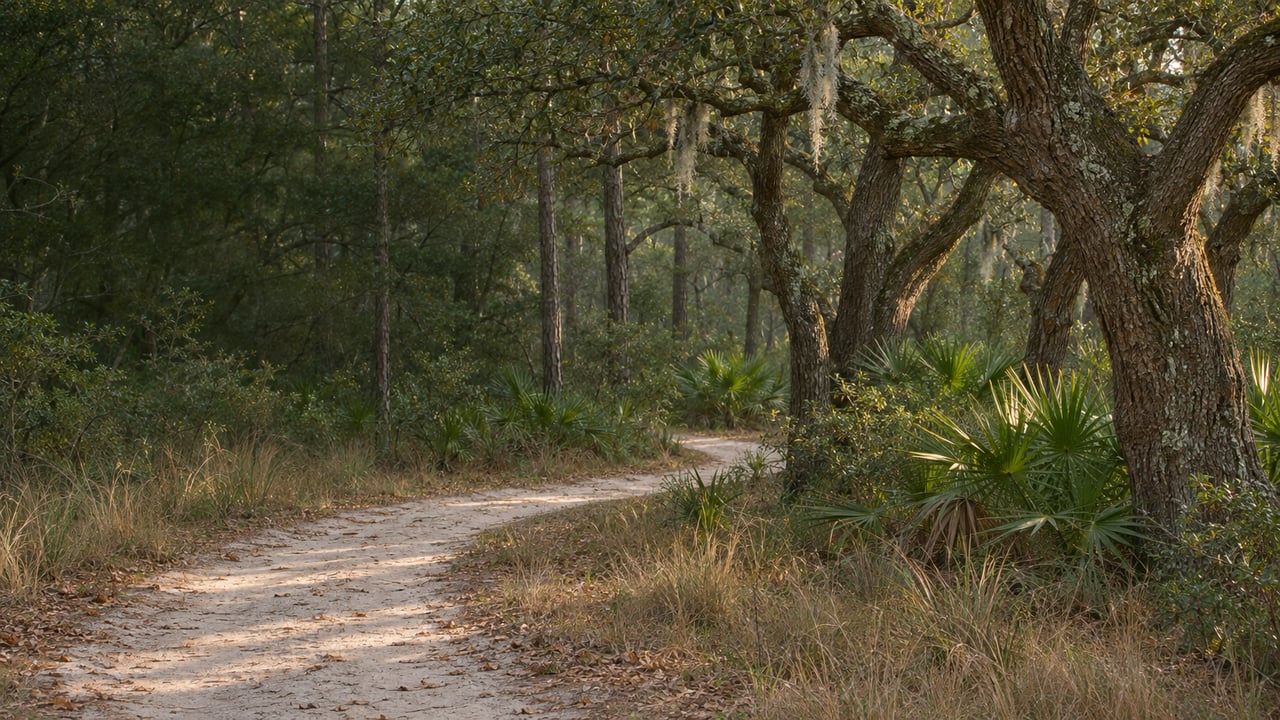
Longfield Stables is Palmetto Bluff's own equestrian center, and it is not small. The property carries a covered arena, an outdoor dressage arena, a turf jump field, and more than ten miles of trails that end at a cross-country course designed by Olympian John Williams. That course is the actual venue for the Hunter Pace, and it is built to test terrain reading and pacing judgment, not just a horse's willingness to jump.
The Lowcountry Hunt is a separate organization that uses Longfield's course for its own event once a year, typically in October. Riders register through the Hunt directly, not through the stable's own booking system, and the paperwork reflects that split: teams submit registration forms and waivers to a Lowcountry Hunt contact, along with proof of a negative Coggins test for each horse.
For residents, the practical difference is that the fall pace uses the Hunt's registration process rather than Longfield's usual booking process.
What a Hunter Pace Actually Measures
The name invites a common mistake. A Hunter Pace is not a horse show with ribbons for style and height. It descends from foxhunting tradition, where riders tried to match the speed a hunt master set while following hounds across open country. Modern paces keep the scoring logic but drop the fox: teams ride a set course and are judged on how closely they match a pre-determined optimal time, one that organizers keep secret until results are posted. Finish too fast and you lose points just as surely as finishing too slow.
That single fact reframes the whole morning. Nobody is chasing a blue ribbon for the biggest jump. Teams are chasing a number nobody can see, which means the actual skill on display is judgment, not speed, and the atmosphere on the course leans more toward quiet concentration than crowd-pleasing spectacle.
Fall Entry Fees and Registration Details
Last fall's running, held October 11, priced entry the way most local paces do, with a discount for planning ahead. Riders who registered and paid before October 5 paid $65 per adult and $40 per junior rider 17 and under, with lunch included. Anyone who registered after that date, or showed up the morning of, paid $75 and $45. Guests who wanted lunch without riding paid a flat $15, due by the same October 5 cutoff.
The rest of the logistics are worth knowing before you plan a Saturday around it:
- Every rider needs current proof of a negative Coggins test, no exceptions
- Registration and waiver forms go to the Lowcountry Hunt directly, not to Longfield's front desk
- Teams must complete the course by 1:00 PM and be present at the finish to qualify for awards
- Awards go to first and second place in each division, plus Best Turned Out and Best Team Name, a detail that tells you as much about the event's spirit as any scoring rule
- Riders should bring their own chair and cooler; bottled water is provided for people, and a hose and trough are set up for horses
That last award category, Best Team Name, is a small tell. A competition built entirely around hiding the winning time from participants isn't really optimized for bragging rights. It's optimized for a fun Saturday that happens to involve horses and a stopwatch.
Same Grounds, Different Host, Spring and Fall
Here is the part that generic write-ups of Longfield tend to flatten into one undifferentiated "hunter pace season." There are two paces a year, and they are not run by the same people.
The spring pace, held on a Saturday in early May the last two years running, is organized directly by Longfield Stables itself. It shows up on the calendar under the stable's own name, follows the stable's own booking process, and reads as an in-house community event, closer in spirit to a lesson day than an outside competition.
The fall pace belongs to the Lowcountry Hunt. Same course, same grounds, entirely different organizing body, entirely different paperwork trail. Residents who attended the May event should keep that distinction in mind when planning for the fall pace.
The Horses Are Not Interchangeable Either
Part of what makes Longfield feel like a neighborhood fixture rather than a rental barn is that its own horses have names, histories, and specific quirks residents pick up over repeated visits. Winter is an all-white mare with pink skin rare enough that she wears sunscreen and has appeared in weddings and a Ralph Lauren photo shoot. Virginia, a palomino pony, came to the Bluff from Onyxford Farm in Virginia and carries the show name Onyxford's Miss Virginia. Bravo, a Marsh Tacky, once learned to jump while his rider flew a kite from his back during a demonstration highlighting the breed.
These are the same horses many residents' children take pony lessons on during an ordinary Tuesday, giving residents a familiar point of connection with the fall pace and its visiting riders.
Watching From the Rail
Because a Hunter Pace has no grandstand and no announcer calling times, spectating works differently than showing up to a horse show. Vendors set up tables the morning of the event, and the course itself is walkable in sections if you want to watch teams navigate specific stretches rather than wait at the finish. Since the scoring depends on a hidden optimal time, there's no leaderboard updating in real time. The only moment that resolves anything is when results post after the noon cutoff.
If you're a resident who doesn't ride but wants to understand what a fall Saturday at Longfield actually involves, that's the picture: Longfield's course, the Lowcountry Hunt's rulebook, a scoring system built to reward restraint over speed, and a stable full of horses who also teach someone's kid to trot.
Palmetto Bluff's calendar is full of moments like this, traditions the community hosts and different groups organize on property built for exactly that kind of sharing. Knowing who organizes an event and how to register is a small thing, but it's useful local knowledge for residents paying attention over multiple seasons.
If you're weighing a move to Palmetto Bluff and want that same resident's-eye read on the community, not just the amenity list, Dr. Lori Whatley offers private consultations for buyers considering the Bluff, drawing on both full-time residency here and a Member Advisory Team seat inside the community. Request a private consultation when you're ready to talk specifics.