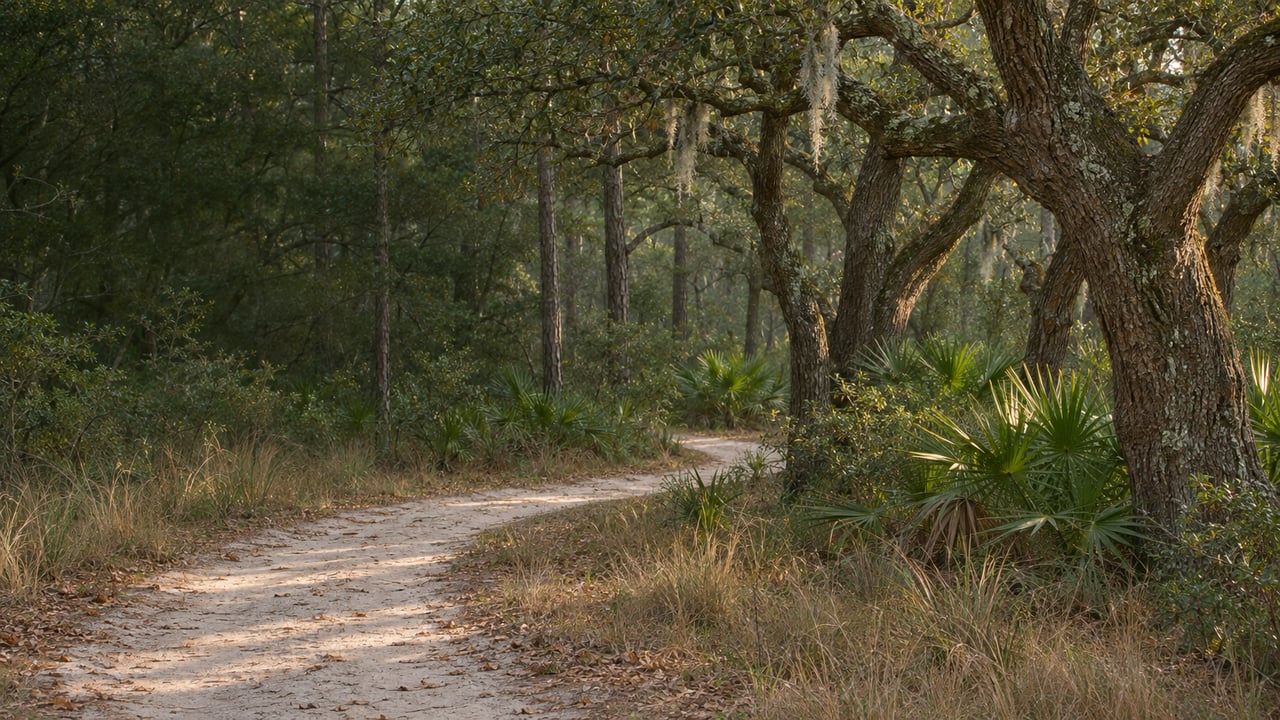
Rephraim Cemetery Road runs off Palmetto Bluff Road in Bluffton. The Beaufort County cemetery directory gives its location as N 32°12.610′, W 80°56.260′. Find a Grave counts 70 memorials there. On Wednesday, November 11, Palmetto Bluff's archaeologists will lead a small reserved group to the site for Veterans Day.
The Conservancy's events calendar describes the purpose in one sentence:
"Join Palmetto Bluff Archaeologists on a visit to Rephraim Cemetery to honor the Union soldiers who are buried on the plantation where they were once enslaved."
The soldiers honored at Rephraim were enslaved on this land, left it during the war to serve in the Union Army, and were buried here afterward. A Veterans Day visit to Rephraim honors service, and it also traces a round trip that started and ended a few miles from today's Wilson Village.
A plantation with its own name
Long before anyone called this land Palmetto Bluff, it was a patchwork. The Conservancy's history and archaeology page explains that Robert Wright, a chief justice of the South Carolina colony, and George Anson, a British naval officer, bought the land in 1730. Starting in 1757 it was divided and sold in tracts averaging 1,000 acres, which became about 15 separate plantations. The name Palmetto Bluff came much later, after Richard T. Wilson Jr. acquired the land in 1902.
Rephraim was one of those plantations. In 2005 an archaeological report filed in the Digital Archaeological Record documented data recovery at two Rephraim Plantation sites, catalogued as 38BU1385 and 38BU1803. The report is titled "Meet, O Lord, On the Milk-White Horse." The report's ownership chronology lists Sarah Hort as owner from 1826 to 1870 and records that she "freed her family's slaves."
According to the Conservancy, each Palmetto Bluff plantation held between 15 and 75 enslaved children and adults. They grew indigo, rice, and Sea Island cotton for the Savannah markets, along with corn, beans, and sweet potatoes for food. The men buried at Rephraim came out of that world.
The route out, and the route home
The Conservancy's published history, along with the records kept by Historic Mitchelville Freedom Park and the National Park Service, outlines how a man enslaved at the Bluff could end up a Union veteran buried back on the same land:
- November 1861. Union troops took Hilton Head Island, and the retreating Confederate forces burned buildings and supplies as they left. White families at Palmetto Bluff left too. The men joined the Confederate side and the women and children moved inland. The enslaved people left behind at the Bluff also fled.
- To Hilton Head. They escaped to the federal encampment on the island, the Conservancy writes, "where they would help found Mitchelville, a progressive community of freed people."
- February 1862. Historic Mitchelville Freedom Park's timeline dates the first enlistments to this month, when Gen. David Hunter "began enlisting the formerly enslaved refugees in the Union Army." The park ties that effort to the First South Carolina Volunteers, which formed later.
- September 1862 and after. Gen. Ormsby Mitchel replaced Hunter in command and ordered a village "built by and for the freedman/refugees," with homes, police protection, and a school, according to the park's founding account. The park calls Mitchelville "the first self-governed town" for formerly enslaved people. It had a mayor, councilmen, a treasurer, and other officers. The National Park Service describes Camp Saxton, starting in fall 1862, as the "first recruit depot for Black soldiers in the Civil War."
- After the war. "Many of the formerly enslaved men joined the Union Army to fight for freedom," the Conservancy writes, "and several of these veterans are buried at Palmetto Bluff." Black families who returned to the Bluff rented or bought small tracts to farm, in some cases from the people who had enslaved them.
Seen in order, the five steps explain the event's wording. The Veterans Day walk marks the end of a path that started where the cemetery stands, ran through the war, and came back. Coming back took deliberate effort. The local economy was devastated, and the land these veterans returned to was land they now had to rent or buy.
Why the names travel with the archaeologists
The Conservancy's public history says "several" veterans and does not give a roster. Those stories are carried in the archaeology program, which is why the November 11 visit is led by archaeologists and not offered as a self-guided marker tour.
That program goes back further than most residents may assume. Documentation at Palmetto Bluff began in 2000. Dr. Mary Socci was hired in 2004 to oversee the work and share it with residents, visitors, and the wider community, and Palmetto Bluff Archaeologist Katie Epps carries it on today. The staff maintains and helps restore the cemeteries and researches historical documents. According to Palmetto Bluff's "Resurrecting Stones" story, the team also keeps cemetery maps and records of headstone and footstone inscriptions.
A 2024 Palmetto Bluff story, "Resurrecting Stones," explains the scale. The archaeology team began restoring cemeteries in 2016, and the program now covers 12 of them. Five began as burial grounds for enslaved people and were later used by freed people and their descendants. The same story shows how this research reconnects families. Rollen Chalmers visited in 2022 and learned that his great-grandmother, Maria Chalmers, is buried at Landings Cemetery, and that his great-grandfather, William Chalmers, leased land and farmed rice at Palmetto Bluff. Landings is a different cemetery from Rephraim. Still, the Chalmers account follows the same pattern as step five above: a family that farmed this land after emancipation, with a grave that ties it here.
Planning Veterans Day morning
The Rephraim visit is on Wednesday, November 11, and requires a reservation through [email protected]. The Conservancy asks participants to wear closed-toed shoes and long pants. An older event page listed 9:00 to 11:30 a.m., but it carries no year, so confirm the start time when you reserve.
Expect a scheduling conflict. Beaufort County's Veterans Day parade starts at 10 a.m. the same morning, with lineup at 8 a.m. on Adventure Street. The route begins in front of Beaufort National Cemetery, follows Boundary Street and Bay Street, and ends at Boundary and Bladen Streets. If the Rephraim visit keeps something close to its earlier hours, households will need to choose one or the other.
Two other Conservancy dates fit around Veterans Day:
- Thursday, November 5. Palmetto Bluff archaeologists walk the cemeteries of Wilson Village and tell "tales of the lives of those who lay at rest." The same reservation email and dress requirements apply.
- November 20 and November 23. The Conservancy Classroom holds a pop-up shop. Along with shirts, water bottles, and cards, it sells "A Guide to the History of Palmetto Bluff" by Dr. Socci, and purchases support the Conservancy.
Following the route to Hilton Head
The next stop on the soldiers' route is a short drive away. Historic Mitchelville Freedom Park sits on Hilton Head, where the town in step four once stood. Its upcoming events page had nothing listed for November as of late October. The Reconstruction Era National Historical Park covers the Camp Saxton history. It charges no entrance fee and requires no timed entry. Darrah Hall has been temporarily closed since October 14, 2026. The park's general calendar lists ranger programs at 11 a.m. and 2 p.m., Tuesday through Saturday, plus noon on Saturdays at Pinckney-Porters Chapel. It also notes that programs may change or be canceled, so check before you drive.
Visiting both sites on the same weekend lets you see the route as the soldiers traveled it, from the plantation to the free town to the recruiting depot, before you return to the cemetery off Palmetto Bluff Road where it ended.
If you are new to Palmetto Bluff and wondering where to start with the Conservancy's history walks, Lori Whatley is happy to tell you which ones she has found most rewarding as a full-time resident. Reservations for the Rephraim visit go through [email protected].